
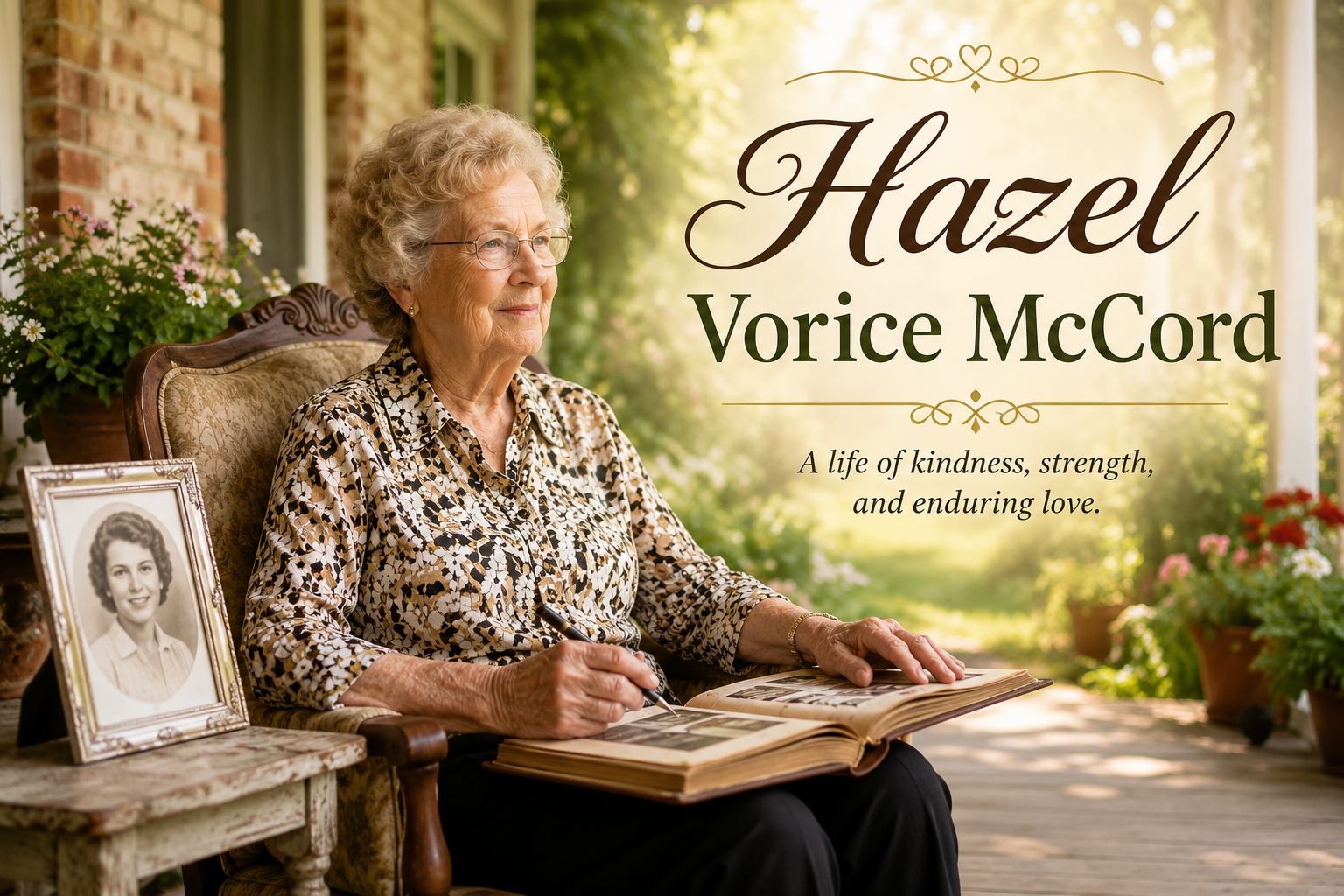
When the name Hazel Vorice McCord surfaces in conversations, it often sparks curiosity and intrigue. Who was she? What did she accomplish? And why does her name continue to resonate with those who encounter it? In a world where countless individuals pass through the pages of history without leaving a trace, Hazel Vorice McCord stands as a name worth exploring a name that carries with it a story waiting to be told. Whether you stumbled upon her name through genealogical research, historical records, or community archives, there is no denying that the pursuit of understanding her life is a journey filled with discovery.
This article delves deep into the available information surrounding Hazel Vorice McCord, examining her background, her potential contributions, and the broader context of her era. While detailed public records about her may be limited, the very act of searching for her story reveals much about how we preserve and uncover the legacies of individuals who may not have made the headlines but whose lives nonetheless shaped the communities around them. Join us as we explore the fascinating narrative of Hazel Vorice McCord a name that deserves recognition, remembrance, and reflection.
Who Was Hazel Vorice McCord? Tracing Her Origins and Background
Understanding the Name and Its Historical Context
The name Hazel Vorice McCord is a distinctive one, combining a classic first name with a less common middle name and a surname rooted in Scottish and Irish heritage. “Hazel” gained popularity in the late 19th and early 20th centuries, often associated with the hazel tree — a symbol of wisdom and protection in Celtic mythology. The middle name “Vorice” is particularly unusual, suggesting a possible family name passed down through generations or a unique creation by her parents. The surname “McCord” traces back to Gaelic origins, typically meaning “son of Cord” or relating to the MacMhuirich clan of Scotland. Together, these names paint a picture of a family with deep cultural roots and a tradition of meaningful naming.
Understanding the historical context in which Hazel Vorice McCord lived is essential to appreciating her story. If she was born in the early-to-mid 20th century, she would have grown up during a time of immense social change — two world wars, the Great Depression, the civil rights movement, and the gradual transformation of rural America into a more urbanized society. These forces would have shaped her worldview, her opportunities, and the way her community functioned. Even without extensive public records, placing her name within this broader historical tapestry helps us understand the world she navigated and the challenges she may have faced.
The Search for Biographical Details
For researchers and genealogy enthusiasts, uncovering the life story of Hazel Vorice McCord can be both rewarding and challenging. Public records such as birth certificates, census data, marriage licenses, and obituaries are the primary tools for piecing together her biography. The U.S. Census, conducted every ten years, provides snapshots of individuals at specific moments in time where they lived, who they lived with, and what occupations they held. For someone like Hazel Vorice McCord, these records might reveal her birthplace, her parents’ names, her educational background, and the communities she called home throughout her life.
It is worth noting that the availability of records depends heavily on the era and location in which she lived. Earlier records may be incomplete, damaged, or difficult to access digitally. Additionally, women’s histories are often less documented than men’s, as traditional record-keeping systems frequently centered on male heads of household. This means that discovering the full story of Hazel Vorice McCord may require creative research strategies consulting local historical societies, church records, school yearbooks, and even family bibles. Each piece of evidence, no matter how small, contributes to a more complete picture of who she was and how she lived.
The McCord Family Legacy: Genealogy and Heritage
Tracing the McCord Family Lineage
The McCord surname carries a rich genealogical history that spans centuries and continents. Originating in Scotland and Ireland, the McCord family name migrated to North America during the waves of Scotch-Irish immigration in the 18th and 19th centuries. Many McCord families settled in Pennsylvania, the Carolinas, and later spread across the Midwest and Southern United States. If Hazel Vorice McCord was part of this broader family tree, her ancestors likely experienced the hardships of frontier life, the turbulence of the American Revolution, and the gradual establishment of communities in new territories.
Genealogical research into the McCord family reveals a network of interconnected families who often intermarried, migrated together, and established lasting community bonds. The name appears in land grants, military records, and church registries throughout the American South and Midwest. For anyone researching Hazel Vorice McCord’s place within this lineage, understanding the migration patterns and settlement histories of McCord families can provide valuable clues. DNA genealogy has also become an increasingly powerful tool, allowing descendants to connect with distant relatives and confirm family relationships that paper records alone cannot establish. The McCord family legacy, with its deep roots and wide branches, offers a fascinating backdrop against which Hazel’s individual story unfolds.
The Importance of Family History Preservation
The story of Hazel Vorice McCord underscores a broader truth: the preservation of family history matters. Too often, the stories of ordinary individuals people who didn’t write memoirs or make headlines are lost to time. Photographs fade, letters are discarded, and memories fade with each passing generation. Yet these stories are the fabric of our collective history. They tell us about everyday life, community dynamics, and the values that guided previous generations. By seeking out and documenting the life of someone like Hazel Vorice McCord, we participate in an act of historical preservation that ensures her name and story are not forgotten.
Modern tools have made family history preservation more accessible than ever. Digital archives, online genealogy platforms, and social media groups dedicated to specific surnames or regions have created new avenues for discovery. Families can now collaborate across distances to build shared family trees, upload historical photographs, and record oral histories. For the McCord family specifically, these tools could help connect descendants of various branches, pooling knowledge about ancestors like Hazel Vorice McCord and ensuring that their contributions however modest they may seem recovered from obscurity is a small victory against the erosion of history.
Hazel Vorice McCord’s Potential Contributions and Community Impact

The Role of Women in Community Building
While specific documented achievements of Hazel Vorice McCord may not be widely recorded, it is important to recognize the significant though often unheralded roles that women of her era played in their communities. Throughout the 20th century, women were the backbone of community organizations, church groups, school associations, and local charities. They organized fundraisers, supported schools, tended to the sick, and maintained the social fabric that held communities together. If Hazel Vorice McCord lived during this period, she almost certainly contributed to her community in ways that, while not making headlines, were deeply meaningful to those around her.
Women of Hazel’s generation often worked both inside and outside the home. Some were teachers, nurses, or business owners; others managed households with remarkable efficiency while also volunteering their time to civic causes. The Great Depression and World War II, in particular, called upon women to take on expanded roles — managing family finances during economic hardship, participating in war effort initiatives, and supporting returning veterans. These contributions were rarely documented in official histories, yet they were essential to the survival and thriving of American communities. Understanding Hazel Vorice McCord’s life means appreciating the quiet, everyday heroism that defined so many women of her time.
Recognizing Unsung Contributions
The challenge of documenting Hazel Vorice McCord’s specific contributions highlights a broader issue in historical research: the systematic under-recognition of ordinary people’s impact. History tends to record the extraordinary — the leaders, the innovators, the trailblazers while the everyday contributions of countless individuals go unnoted. Yet these everyday contributions are what make communities function. The neighbor who checks on the elderly, the volunteer who organizes the church supper, the mother who ensures her children receive an education these acts, repeated across millions of lives, form the foundation of civil society.
For those researching Hazel Vorice McCord, looking beyond traditional sources may yield insights into her contributions. Local newspaper archives often contain social columns that mention community events, church activities, and organizational meetings — places where women’s names appear alongside their activities. School records may show her involvement in parent-teacher associations. Church minutes might reference her participation in women’s circles or missionary societies. Each of these fragments, when assembled, creates a portrait of a life lived in service to others. By seeking out these overlooked records, we not only honor Hazel Vorice McCord but also challenge the historical narrative to be more inclusive of the everyday heroes who shaped our world.
The Cultural and Historical Significance of Remembering Hazel Vorice McCord
Why Every Name Matters in the Historical Record
In an age of big data and digital archives, it might seem that every significant life is already documented. Yet the reality is that countless individuals including Hazel Vorice McCord — exist in the margins of history, their stories known only to family members or preserved in scattered local records. The movement to recover and document these lives is not merely an academic exercise; it is a moral imperative. Every person who lived contributed to the human story, and every name recovered from obscurity enriches our understanding of who we are and how we got here. Remembering Hazel Vorice McCord is an act of historical justice — a refusal to let her story slip into permanent anonymity.
The cultural significance of this work extends beyond individual families. When we document the lives of people like Hazel Vorice McCord, we create a more complete and accurate historical record. We challenge the dominance of elite narratives and ensure that the experiences of ordinary people — women, rural communities, working-class families are represented. This inclusive approach to history allows future generations to see themselves reflected in the past, to understand that their lives and contributions matter, and to draw inspiration from those who came before them. In this way, the search for Hazel Vorice McCord is not just about one person it is about the kind of history we choose to write and the values we choose to uphold.
Connecting Past and Present Through Genealogy
Genealogy has experienced a remarkable surge in popularity over the past two decades, fueled by DNA testing kits, online databases, and television programs that explore celebrity family histories. This renewed interest in personal ancestry has brought names like Hazel Vorice McCord into sharper focus, as descendants and researchers alike seek to understand their roots. The connection between past and present is powerful: knowing where we come from shapes our sense of identity, our understanding of family, and our place within a larger historical narrative. For descendants of the McCord family, discovering Hazel’s story could be a deeply meaningful experience — a way to connect with ancestors they never knew and to understand the forces that shaped their family’s journey.
This genealogical movement also has broader cultural implications. As more people engage with their family histories, there is a growing appreciation for the diversity and complexity of American origins. Family trees reveal interconnections across racial, ethnic, and geographic lines, challenging simplistic narratives about identity and belonging. The story of Hazel Vorice McCord, whatever specific details it ultimately reveals, is part of this larger tapestry a thread in the fabric of American history that, when pulled, may unravel connections to unexpected places and people. By pursuing these connections, we build not only a richer understanding of the past but also a more compassionate and inclusive vision for the future.
How to Research Hazel Vorice McCord: A Practical Guide for Genealogists
Essential Resources and Tools
For anyone inspired to research Hazel Vorice McCord further, a variety of resources are available to aid in the search. The first stop for most genealogists is Ancestry.com, which hosts billions of historical records including census data, military records, immigration documents, and family trees submitted by users. FamilySearch.org, operated by the Church of Jesus Christ of Latter-day Saints, offers free access to an extensive collection of records and is an invaluable tool for researchers at any level. Other platforms, such as FindAGrave.com and Newspapers.com, provide access to cemetery records and historical newspaper archives, respectively both of which can yield critical information about an individual’s life and death.
Beyond online resources, local repositories are often the key to unlocking difficult genealogical puzzles. County courthouses maintain records of births, deaths, marriages, and property transactions. Local libraries and historical societies frequently hold unique collections family files, oral history recordings, photographs, and local newspapers on microfilm that are not available anywhere else. Church archives can provide baptismal, marriage, and burial records. For someone like Hazel Vorice McCord, whose story may be rooted in a specific community, these local resources could be the difference between a name on a page and a fully realized life story. Researchers should not underestimate the value of visiting these institutions in person and speaking with local historians who may have personal knowledge of the families in their area.
Best Practices for Genealogical Research
Successful genealogical research requires patience, organization, and a critical eye. When searching for Hazel Vorice McCord, it is important to begin with what is known and work backward. Start with any family knowledge — names, dates, locations — and use these as anchors for further research. Document every source, even those that seem inconclusive, as they may become relevant later. Be prepared for name variations: “Vorice” might appear as “Voris,” “Vorrice,” or even “Voris” in different records, and transcription errors are common in digitized documents. Flexibility and creativity in search strategies are essential.
It is also important to approach genealogical research with an awareness of its limitations and ethical considerations. Not all records are accurate, and family stories passed down orally may contain embellishments or errors. DNA testing, while powerful, can reveal unexpected family relationships that may be sensitive. Researchers should handle discoveries with care and respect, particularly when sharing information with living relatives. Above all, the goal should be to honor the memory of individuals like Hazel Vorice McCord by telling their stories as accurately and compassionately as possible. Genealogy is not just about collecting names and dates — it is about understanding the human experiences behind the records and preserving those experiences for the generations to come.
Conclusion
The story of Hazel Vorice McCord is, in many ways, the story of countless individuals whose lives were lived with purpose and meaning but whose records have been scattered by time. While specific details about her life may remain elusive, the very act of searching for her story is a testament to the enduring human desire to remember, to connect, and to honor those who came before us. Through genealogical research, historical investigation, and the preservation of family narratives, we can ensure that names like Hazel Vorice McCord are not lost to history but instead serve as bridges between past and present.
Whether you are a direct descendant, a genealogy enthusiast, or simply someone who stumbled upon her name and felt compelled to learn more, the journey to understand Hazel Vorice McCord is a worthwhile one. It is a reminder that every life has value, every name has a story, and every story deserves to be told. As we continue to uncover the details of her life piece by piece, record by record — we contribute to a richer, more inclusive historical record that celebrates not just the famous and the powerful but the ordinary people who built the world we inherit. Hazel Vorice McCord’s name may not appear in textbooks, but it lives on in the hearts of those who remember and in the records that refuse to let her be forgotten.
Guardians of Mathematica: The Ultimate Guide to Mastering Math Through Epic Adventure
Frequently Asked Questions (FAQs)
1. Who was Hazel Vorice McCord?
Hazel Vorice McCord is an individual whose name has generated interest among genealogists and family history researchers. While detailed public information about her life may be limited, her name appears in historical and genealogical contexts, prompting further investigation into her background, family connections, and potential contributions to her community.
2. What does the name “Vorice” mean?
The middle name “Vorice” is uncommon and may have originated as a family surname passed down as a given name, a creative variation of another name, or a name with personal significance to her parents. Further genealogical research into her family tree may reveal its origins.
3. Where can I find records about Hazel Vorice McCord?
Records about Hazel Vorice McCord may be found through online genealogy platforms such as Ancestry.com and FamilySearch.org, as well as local resources including county courthouses, historical societies, church archives, and cemetery records. Local newspapers on microfilm can also be valuable sources.
4. Is the McCord surname of Scottish or Irish origin?
The McCord surname has both Scottish and Irish roots. It is generally believed to derive from Gaelic origins, with connections to the MacMhuirich clan of Scotland. Many McCord families migrated to North America during the 18th and 19th centuries, settling primarily in Pennsylvania, the Carolinas, and later across the Midwest and South.
5. Why is it important to research ordinary people like Hazel Vorice McCord?
Researching individuals like Hazel Vorice McCord helps create a more complete and inclusive historical record. Ordinary people’s lives reveal valuable insights about community life, social structures, and cultural values that are often overlooked in traditional historical narratives focused on prominent figures.
6. How can DNA testing help in researching Hazel Vorice McCord’s family?
DNA testing can help confirm family relationships, connect living descendants with distant relatives, and verify genealogical findings that paper records alone cannot establish. Autosomal DNA tests, in particular, can reveal connections across several generations and help map out the McCord family tree.
7. What challenges might I face when researching Hazel Vorice McCord?
Common challenges include incomplete or damaged records, name variations and transcription errors, the under-documentation of women’s lives in historical records, and the difficulty of accessing local archives that have not been digitized. Persistence and creative research strategies are key to overcoming these obstacles.
8. Were there notable McCord families in American history?
Yes, the McCord family name appears throughout American history in various contexts, including military service, land grants, and community leadership. Several McCord individuals have been documented in Revolutionary War records, frontier settlements, and local government. Researching specific McCord lineages can reveal connections to these broader historical narratives.
9. How can I preserve my own family history inspired by Hazel Vorice McCord’s story?
You can preserve your family history by conducting interviews with older relatives, digitizing photographs and documents, recording oral histories, building family trees on genealogy platforms, and writing down family stories. Local historical societies are often grateful for donated materials that document community families.
10. What should I do if I find information about Hazel Vorice McCord?
If you discover information about Hazel Vorice McCord, consider sharing it with genealogical databases, family history forums, and local historical societies. Document your sources carefully, verify findings where possible, and handle any sensitive information particularly that involving living relatives — with respect and discretion. Your discoveries could help other researchers and descendants piece together the full story of her life.